
This program consists of:
1) Resistance Training (Slow Training Method)
2) Aerobic Training (Interval Walking)
1) Resistance Training
■ What is Slow Training?
Slow training is a strength training method performed with controlled, slow movements to reduce joint stress while effectively stimulating muscles.
✔ 3–5 seconds to lift
✔ 3–5 seconds to lower
Developed by Japanese researchers (Ishii & Tanimoto, 2006, J Appl Physiol).
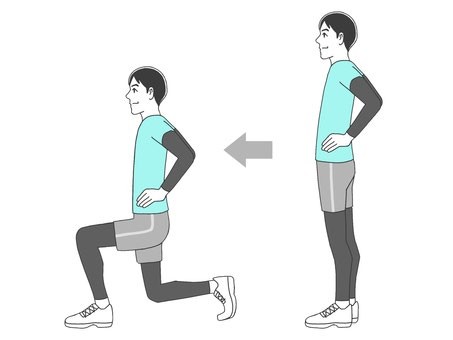
Exercise 1: Leg Lunge
Step forward and backward with legs apart.
Keep your back straight and slowly bend the front knee.
Key Points
• Do not hold your breath
• Align knee and toes
• Do not let the knee move beyond the toes
Levels
Level 1: Chair-supported lunge
Level 2: Chair-assisted back lunge
Level 3: Front lunge without support
Level 4: Front lunge holding light weights (e.g., 500mL bottle)
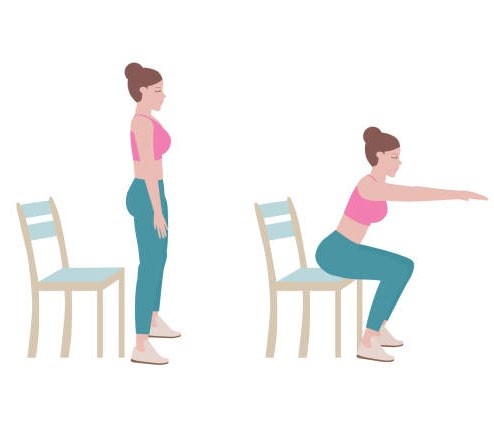
Exercise 2: Squat
Stand with feet shoulder-width apart.
Lower your hips slowly while keeping your back straight.
Key Points
• Do not hold your breath
• Align knees and toes
• Do not let knees move beyond toes
• If ankles are stiff, slightly elevate heels
Levels
Level 1: Knee-touch squat
Level 2: Chair squat
Level 3: Standard squat
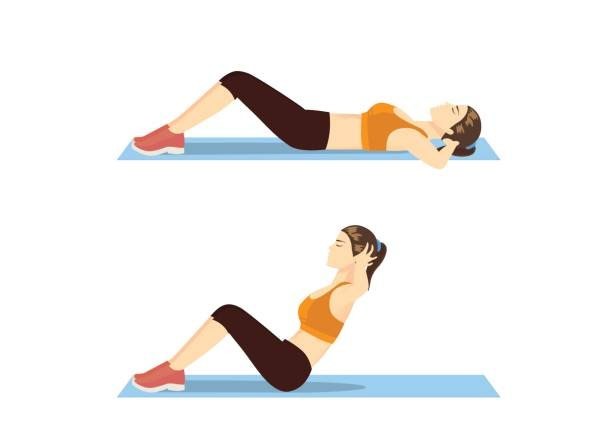
Exercise 3: Sit-Up (Abdominal Exercise)
Lie on your back with knees bent.
Lift your upper body slowly and return.
Key Points
• Do not hold your breath
• Keep back extended (avoid rounding)
• Engage abdominal pressure to stabilize lower back
Levels
Level 1: Knee-touch sit-up
Level 2: Knee-touch twist
Level 3: Russian twist
Bonus: Leg raise
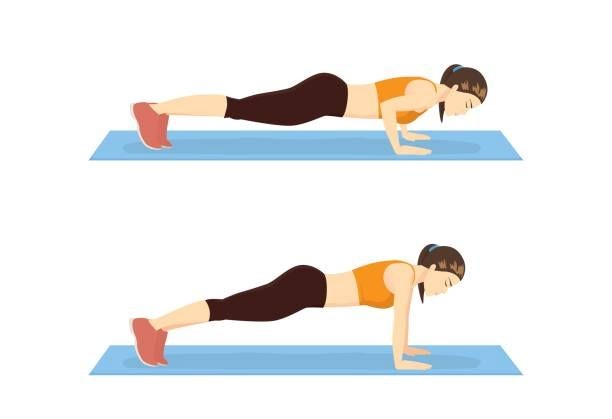
Exercise 4: Push-Up
Place hands shoulder-width apart.
Keep body straight and slowly lower and push up.
Key Points
• Do not hold your breath
• Adjust wrist and elbow position to reduce strain
• Keep body in a straight line
• Do not flare elbows excessively
Levels
Level 1: Wall push-up
Level 2: Knee push-up
Level 3: Standard push-up
Strength Training Guidelines
✔ At least 3 days per week (preferably every other day)
✔ 5–10 repetitions per exercise
✔ 1–3 sets
✔ Rest 30–60 seconds between sets
If you already train at a gym, add this program to your routine.
2) Aerobic Training
■ What is Interval Walking?
Interval walking alternates between fast walking and slow walking.
It improves cardiovascular fitness and endurance and helps prevent lifestyle-related diseases.
Developed by a Japanese research group led by Dr. Hiroshi Nose (Nemoto et al., 2007, Mayo Clin Proc).
Basic format:
Alternate 2–3 minutes fast walking with 2–3 minutes slow walking
Repeat for 3–5 sets
Program Levels
Level 1 (Introductory)
Fast walk 2 min + Slow walk 2 min
3–5 sets per day
3–5 days per week
RPE 11–12 (light to somewhat hard, conversation possible)
40–50% HRR / 65–70% HRmax
Level 2 (Beginner)
Fast walk 3 min + Slow walk 3 min
3–5 sets per day
3–4 days per week
RPE 12–13 (moderately hard)
50–60% HRR / 70–75% HRmax
Level 3 (Intermediate)
Fast walk 3 min (faster pace) + Slow walk 3 min
3–5 sets per day
4 days per week
RPE 13–14 (hard, conversation difficult)
60–70% HRR / 75–80% HRmax
Level 4 (Advanced)
Fast walk 3 min + Slow walk 1 min
3–5 sets per day
4–5 days per week
RPE 14–15 (very hard)
70–80% HRR / 80–85% HRmax
Heart Rate Calculation
Estimated Maximum Heart Rate (HRmax)
HRmax = 207 − (0.7 × age)
Heart Rate Reserve (HRR)
HRR = HRmax − Resting Heart Rate
Target Heart Rate
Target HR = Resting HR + (HRR × target intensity %)
 WellAge - 更年期障害予防~自律神経を整え、心身に活力を